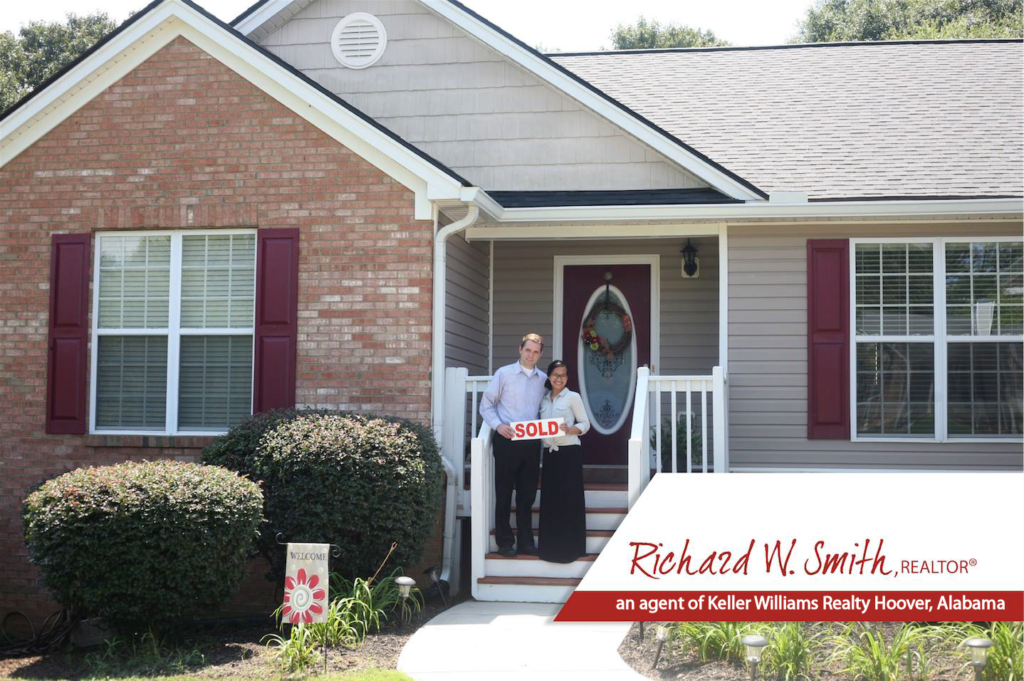
This course is meant to help homebuyers who would like to purchase a home but do not know where to start! Of course it is impossible for me to teach you everything there is know, but these lessons will give you a basic overview of this seemingly difficult process! My goal is that this course will help you avoid the pitfalls that many homebuyers make and help make you more comfortable throughout the whole process resulting in a great home-buying experience.
I hope this short and simple course will be helpful to you!
Richard W. Smith
Direct: 205-433-9840
Office: 205-822-2272
Email: richard.smith@kw.com
Download my mobile app here to shop the latest houses in your area! http://app.kw.com/KW2EL1TID
Richard is a realtor with Keller Williams Realty in Hoover, Alabama.
DISCLAIMER: Every home-buying experience is different and I am not an attorney. Do not take everything I say as gospel. Do the research on anything I say here for yourself. Also, remember things change as time goes on.
MY STORY
So who am I? I’m a realtor in Alabama now but several years ago I was in your shoes. I wanted to buy a home but did not have a clue where to start. I knew I needed a loan so I called a few local lenders to see what I needed to do. I had about $5,000 that I was going to use for the downpayment, and I had been at my job for about 3 years and at that time my wife and I were averaging about $40-50K a year. I should have no problem right?
WRONG. (And there are ways out there to buy a house without cash, but this is just my story). The banks shrugged me off, telling me that I did not have enough down-payment. I needed to refinance my car or save some more and come back in a year or two. I was devastated…no ANGRY is probably a better word. I had great credit, a steady job, good renting history, etc. This was unfair!
So we worked harder and smarter, paid off our car, and saved our money. We finally saved up about $10-12K that we could put towards buying our house. Finally! I called our bank and got a pre-approval letter from them stating how much we could afford in a house (it was really how much of a mortgage or loan I could get).
MY REALTOR EXPERIENCE
A year or so earlier, I had come into contact with a local realtor (he was actually a broker and had his own business), and he showed us some houses. The first house we saw, I wanted to make an offer on. This realtor did not do much else right (I hate to say that), but he at least would not let us put in an offer on the first house that we saw. (He was a nice guy and followed up with us regularly, but he was just not very helpful or informative).
A year later, my boss at the time recommended his realtor. From the moment I spoke to her she was very helpful and informative. She also asked me if I had a Pre-approval Letter from a lender (which I did – more on that in a minute). She then asked me if I was working with another agent. I told her I was but did not want to work with him, and I had not signed any paperwork. She asked how many bedrooms and bathrooms I wanted and what else I wanted in a house, as well as what area I would like to be in. I answered all her questions. She sent me sixty properties, and my wife and I picked out our top three.
Two days later, we went out to look at them and put an offer in for $172K (it was “listed” or “for sale” at $180K or so) with $1000 earnest money on a house that we fell in love with. They countered our offer at $175K, and we accepted. We were “under contract” and on our way to owning our first home. We had a home inspector come inspect the house, and he found a few things wrong but nothing major. However, we were going to have to do a few things so we got the seller to give us another $1000.
On the day of closing (where the contract is “executed” and we get the keys), we went to the closing attorney’s office. We signed off on all the paperwork, and we had our house!
So what can we learn from this story?
TALK TO A LENDER FIRST
Unless you have a lot of cash, you are going to need a LOAN to buy a house. Talk to a lender and get pre-qualified to see what you can afford in a house. However, pre-qualification is just an educated guess. What you will really need BEFORE you ever look at a house is a Pre-Approval Letter. This is an official letter from a lender stating how much of a loan you can afford based on different criteria including, but not limited to the following: your income, how much you have for a down-payment, your credit history, your employment status and income history.
Also, just because you get the Pre-Approval letter from a certain lender (let’s make up a bank and say First Bank), does not mean that you HAVE to use First Bank for your loan. The Pre-Approval Letter is just pretty good proof when you go to look at a house and want to put an offer in, that you can afford this house. In a case where a house gets two offers that are exactly alike except one has the Pre-Approval Letter and one does not… guess who is more likely to get their offer accepted? The one with the Pre-Approval.
In fact, many realtors will not even show you a house until you send them or show them your Pre-approval Letter. Otherwise you may be wasting not only their time but your own as well. It shows that you are seriously looking for a house, that you are “ready to buy” if you find the right one, and that you have the ability to buy it.
If you do not have a Pre-Approval Letter from a lender, you may want to stop here and call your lender (I can recommend a few also) and get the process started. It can take a few days or more. When you actually find the house you want and put an offer in, at that point you can begin the mortgage process. I recommend shopping two or three lenders and see who gives you the best deal. And best deal can mean different things…find a lender that will educate you and be informative on what all the different things like discount points, interest rate, etc. mean.
MY MORTGAGE STORY
After our offer was accepted, my realtor referred me to a lender next door to them that would help me. I got a quote from her and took it home. Then I called another lender across town and asked him for a quote. He gave me his quote. I told them I would be shopping the loan with others. Lender #2 gave me an awesome deal, and he was also very informative and helpful when I talked to him. He explained what everything meant including the confusing terms like “discount points.”
I took his quote to Lender #1 to give her first chance, and she could not believe what an awesome deal he had given me. She could not even understand how I had gotten it. I assumed that meant I was in good hands with Lender #2. And I was. I left the closing (where everything is finalized and you get the keys to the house) with $3000-4000 MORE in my pocket and a lower interest rate (that means I pay less interest over the life of the loan).
Moral of story: AFTER YOU FIND YOUR HOUSE, SHOP YOUR MORTGAGE WITH MULTIPLE LENDERS
REMEMBER: Get your pre-approval from just one lender (maybe two if the first one is not helpful). They are pulling your credit when they pre-approve you, and you can request this from them so that you can give it to the other lender. You don’t want your credit pulled too much. Once is enough because too many times can hurt you!
TIP: Don’t make any big purchases (cars, furniture) at this time – it may cancel your ability to get a mortgage.
BAD NEWS OR GOOD NEWS?
So what was the news when you spoke to your lender? Good or bad? If it was good and you have the Pre-Approval Letter, great! Start shopping for houses!
Bad? I know the feeling. Do what we did. Buckle down, work harder, pay off debt, save money, and come back!
SHOPPING FOR YOUR HOUSE
Please, please please…for your OWN good…find a good realtor when you start shopping for your house. You can shop online on the “big name websites” and you might find your house on there. But (at this point in time) the GOOD DEALS are going FAST. That means you need to talk to a good realtor that will set you up on an email notification list or website where you find out about houses that fit your needs (and criteria) DAILY. That way when that good deal “dream house” comes across, you can be the FIRST ONE to jump on it.
PICKING THE RIGHT REALTOR
How will you know if they are a good realtor? They will DO what they SAY they will DO. Here’s how you test them. When you call them, they will ask you three main things: 1) are you working with another agent, 2) have you spoken to a lender and can you send me a Pre-Approval Letter or are you paying cash, and 3) what are you looking for in a house with NEEDS versus WANTS?
-
Working with another agent means have you signed a “Buyer Agency Agreement” with another agent. That agreement means an agent is representing you and have YOUR best interests in mind even ahead of their own. It means they are on YOUR side. You should definitely sign one…but it also usually says “you agree to work with me and only me and if you find a house anywhere for the next “90” (or whatever) days, I will get paid a commission fee for helping you.” (Usually this comes out of the seller’s fees, but if it doesn’t – because everything is negotiable – you may be liable to pay them and these fees can be 2-3% – or whatever, they are negotiable so it’s whatever it says in the Buyer Agency Agreement you sign – of the house’s price).
2) Spoken to a lender and gotten a Pre-Approval Letter or are you paying cash? A good realtor will help
you make sure you are not wasting your time or theirs. Because that’s what you’re doing if you don’t have cash and haven’t gotten your Pre-Approval Letter either.
3) NEEDS versus WANTS. You probably NEED three bedrooms and two bathrooms if you have two or
three children. You may NEED a house away from a busy road if you have kids. You also probably NEED a house that is located a certain distance from your job(s), church, etc. However, you probably WANT a fence in the backyard (that can be built), beautifully painted rooms (rooms can be painted), and a pool table downstairs (that can be purchased). Make a list (at least a mental one) of what you NEED versus what you WANT. You don’t want to miss out on your dream house because you give the realtor the wrong criteria to send you. (A really good realtor will ask questions and find out anyways.)
CLOSING ATTORNEY
Do some research and find a good closing attorney. Shop around if you want to. When you put the offer in, you can also pick where you want to close! If you don’t have a preference, your realtor can probably pick one.
FIND A REALTOR THAT IS HELPFUL, INFORMATIVE, AND PERSONABLE
As homebuyers, we actually fired out first realtor because we honestly did not really find him helpful. He did not teach us anything or give us information. He opened the house and let us look inside but didn’t really give us any feedback on the property. We honestly felt uncomfortable around him.
THE PERFECT ONE
As soon as I talked to the second realtor, I knew she was the one. She was more helpful in five minutes than the other one had been in five MONTHS. She also had a great personality and seemed really nice and sweet. And she was! We had a perfect experience. Don’t just go with any realtor. Find one that you like, feel comfortable around and that is knowledgeable too!
FINDING THE RIGHT HOME
Once we told our “perfect realtor” what we were looking for, she sent us about sixty homes that fit our criteria and were in the right area that we needed to be in. We looked through them and picked out our top three. Then we went and saw them in person with our “perfect realtor.” The third house we saw was perfect. We went back to her office that afternoon and wrote up the offer and gave her the earnest money check.
EARNEST MONEY CHECK
What’s up with the earnest money check? It is not legally required. (Just like the Pre-Approval Letter). However, it shows that you are serious about the property you are putting an offer in on, and it shows some proof that you probably have the money to buy it too. It’s not required by law, but IF a seller gets two exact offers except that one has earnest money and the other one does not…guess whose offer is more likely to get accepted? 99.9% of the time, you will want to give an earnest money deposit.
HOW MUCH?
As a buyer, put down as little as possible. Usually it’s 1% of the purchase price of the home, but for many homes I usually will recommend doing $500-$1000 depending on the price of the home.
WHAT HAPPENS TO THE MONEY?
Whoever the contract states is going to hold the earnest money – that’s who is going to hold the earnest money. Usually it is the broker of the person selling the house. They are required to put it in a trust fund that is only for trust funds or they can hold the check. (This is very strictly regulated.) They also can’t just do whatever they want with it. However, once you give it, it’s not just your money anymore. It’s half yours and half the sellers. If the buyer’s broker or selling agent’s broker holds the earnest money (or even deposits it in their trust fund), BOTH parties (you and the seller) have to AGREE with a “Mutual Release Form” who gets the money.
Also, if the contract falls through because the inspection shows something badly wrong with the house, you will usually get the money back. If the contract goes through and closes, usually the money goes towards your downpayment. But if you back out for no reason after making the seller jump through a lot of hoops, they may not want to give your money back. If the parties can’t agree, it will go to court for a judge to decide. This does not happen often, but it DOES happen.
THIS IS WHERE IT GOES DOWN – THE OFFER AND NEGOTIATION
This is where you really need a good realtor on your side. Any real estate agent can open the door and let you check out a house. But it takes a GOOD realtor to help you get YOUR offer accepted and THEN go through the negotiation process and make sure you get the best deal you can. They will also help you make sure that the contract does not “fall through” (get cancelled). In other words, they will help you get the house you want.
Remember, many contracts fall through because one or the other party make unreasonable expectations or demands on the other party. A good realtor will tell you the truth, and if you listen to them they will make sure you get the house you want.
TIP: Anybody can open the door to look at a house but not just anybody can help you get IN the house.
CLOSING COSTS
Closing costs are the costs associated with the closing (where you pay your down-payment and get the keys to the house – where it becomes your house). These are usually around 3% of the house’s price, but the cost depends on the closing attorney’s fees, the lender’s fees, the title company fees, and the list goes on…When I sold my house for $180K, the closing costs were around $5000. Normally the SELLER will pay the closing costs or at least part of them. A good realtor will put in your offer (depending on the situtation) that the seller is to pay “up to $5000 in closing costs and pre-pays.”
PRE-PAYMENTS (PRE-PAYS)
What are those? Simple. The seller of the house pays some things in advance or not in advance. For example, maybe they paid the houses taxes for the year already, but you are closing on June 30th. That means he needs his money back for July through December. Or maybe it’s the other way around. Maybe he pays his taxes at the end of the year. That means he owes you six months worth of taxes! If taxes are around $200 per month, that’s $1200 he owes you..
LEAVING MONEY ON THE TABLE
You want to put the part about pre-pays in there because let’s say that your contract says “the seller will pay up to $5000 in closing costs” but the closing costs were only $3500. That means the seller just pocketed an additional $1500 that you could have gotten if you had put in the offer “the seller will pay up to $5000 in closing costs and pre-pays.”
APPRAISAL
Your lender is going to do an appraisal of the house to make sure it’s worth what the seller sells it for. So let’s say you buy it for $200,000, but the lender’s appraiser says it only appraises for $190,000. That means you can only get a loan from that lender for $190,000. So you and your realtor ask the seller to come down to $190,000. He says yes and you just saved $10K. Or he says no…then you have to decide how much you love the house. Will you pay an extra $10K out of your pocket to get it? Or do you walk away? That’s up to you.
TIP: Your contract will (or at least should – you better check) have a part in there that states that if the house does not appraise for what you are buying it for, you do not have to buy the house, and the contract is cancelled. It’s usually called something like the “Appraisal Contingency.” The contract is contingent upon appraisal.
REAL ESTATE AGENT COMMISSION AND FEES
Normally your realtor’s commission (even though they are your agent and on your side as stated in the Buyer Agency Agreement) comes out of the seller’s fees. However, check with your realtor on each house because some sellers will (and can) refuse to pay the buyer’s agent. In this case, you may be liable to make sure your realtor gets paid! (And it can be 2-3% of the purchase price – it’s all negotiable and depends on what your realtor charges and what they put on the Buyer Agency Agreement that you signed with them).
In most cases, the commission will be paid out of the seller’s fees, but not always!
HOME INSPECTION
You WANT a home inspection. And unless you ARE a home inspector or general contractor or something like that…you NEED a home inspection. So immediately after you offer and they accept (or you offer, they counter-offer and you accept – as also happens), you have a “grace period” (normally 15 days but whatever you and your realtor put in the contract) to inspect the house. Don’t put this off. Call a home inspector the FIRST day because depending on the season they may be busy and may not be able to come for a week.
You want to be there while the home inspector is inspecting the house. Your realtor may or may not be there depending on their preference. The inspector will show you things wrong with the house (there’s no perfect house) and will send you a report (usually the next day).
THE INSPECTOR’S MAIN JOB
The inspector’s main job is to check the big stuff such as the plumbing, electrical, heat and air conditioning units, roof and BIG stuff like that. He may also point out little stuff, and he may also recommend you to get another more specialized inspector if there is something that sets off alarms for him such as the air conditioning unit not coming or something of a large magnitude. His job is to SAVE you money.
EXAMPLE: You don’t want to buy a car, no matter how nice the paint job and leather seats are inside if it’s going to need a NEW ENGINE. Same with a house. You probably don’t want to buy a house – even if it’s REALLY nice – if it’s going to need a new roof, air conditioner, or electrical system overhaul. Those are aren’t repairs that are in the hundreds of dollars, those repairs are in the THOUSANDS of dollars.
HOW MUCH WILL AN INSPECTOR COST?
Probably around $200-500 depending on what all you want him to do. Most inspectors will do a general inspection of the whole house but charge more for a few extra services such as mold detection. “That’s too expensive!” you may say. No, buying a house WITHOUT an inspection is what can be expensive…Imagine spending all your money buying a house and making the downpayment and then the air conditioner goes out the first month, and it will cost $8000 to replace. Now that’s expensive! And it’s YOUR problem now.
And the inspection will pay for itself because they almost ALWAYS find something wrong and then you tell the seller and they generally either fix it or offer you cash.
HOME WARRANTIES
Any good buyer agent will put in the offer that the seller agrees to put a one year home warranty on the house at a cost of up to $700. That way if something BIG does go bad in the first year, you won’t have to pay for it (except perhaps a small service fee). Usually the seller will agree to that, but everything is negotiable! When we bought our house (we got a warranty), the air conditioner quit working, so we called the warranty people. They sent somebody out and we got a $200-300 problem fixed for $75. And that was a minor problem. Just be sure to read the details of the Home Warranty offered or maybe pay a little to upgrade it. They are all different.
AFTER THE INSPECTION
After the inspection, the inspector finds a few things wrong. You then ask the seller to fix them or give you cash. The seller will either 1) fix the problems (or some of them), 2) offer you cash and you fix them, or 3) refuse to fix anything or give you cash (yikes). At that point, you can either 1) accept his offer and still get the house or 2) reject his offer and the deal falls through and you don’t get the house. Usually he is given 5-7 days (whatever you and your realtor put in the contract) to fix it or reply to you. Then you are given 2-3 days to accept.
And don’t just think you can cancel the deal and then change your mind and come back and get it later. Many sellers will not want to deal with you again because you are “just too much trouble.” Sometimes a sour taste in someone’s mouth will keep them from doing business with you again – no matter what you offer or do.
FINAL WALKTHROUGH
Usually the day before closing (or the morning of), you will walk through the house and inspect it one more time before you finalize it at the lawyer’s office (closing attorney) the next day. If you see anything wrong or not like it is supposed to be according to what has been put in the paperwork, notify your realtor ASAP.
CLOSING
Yes…you’ve finally made it! What can go wrong now? Hopefully nothing! But there’s still PLENTY that can go wrong. If you have a good realtor, lender & attorney, they will have taken care of everything. Make sure to bring your ID with you because the closing attorney will need it. You will probably also be signing a lot of papers.
If everything goes well, in an hour or two (or worst case three or five – hopefully that won’t happen) you will be walking out with the keys to your new house and a boatload of paperwork.
CONGRATULATIONS ON BUYING YOUR NEW HOME!
WELCOME HOME!
I hope this short and simple course has been helpful for you!
Richard W. Smith
Direct: 205-433-9840 :: Office: 205-822-2272
Email: richard.smith@kw.com
Looking to buy a home?
I would love to be your “perfect realtor.”
Contact me to get started today!
Download my mobile app here to shop the latest houses in your area! http://app.kw.com/KW2EL1TID
Richard is a realtor with Keller Williams Realty in Hoover, Alabama.
This course was written by Richard W. Smith.